FUE vs FUT Hair Transplant, Which Method Fits You
, 14 min read, HairFUE editorial team
FUE and FUT both move healthy follicles from the back of the scalp to thinning areas. FUE takes individual follicular units one by one and leaves tiny dot scars, while FUT removes a thin strip of skin and leaves one fine linear scar. The right choice depends on your hairstyle, graft needs and donor area.
That is the short answer. The longer answer matters, because the method you pick shapes how you wear your hair for the rest of your life, how many grafts you can realistically move, and how you plan a second procedure if you ever need one. This guide walks through how each technique actually works on the day, compares them side by side, explains where DHI and Sapphire FUE fit, and ends with the questions worth asking any surgeon before you book.
One note before we start. Everything here is general information. Estimates and ranges are not medical advice, and a surgeon confirms the right method and graft count only after examining your scalp and donor area in person or through a proper photo assessment.
How FUE works, step by step
FUE stands for follicular unit excision (older material calls it follicular unit extraction). Hair naturally grows in small groups called follicular units, usually containing one to four hairs each. FUE harvests these units individually, so the donor area is never cut open as a single wound. If you want the full picture of the procedure, our FUE hair transplant guide covers it in more depth.
Preparing the donor area
In a classic FUE procedure, the donor area at the back and sides of the head is shaved short, commonly down to a millimetre or two. Short hair lets the team see the angle and direction of each follicle as it exits the skin, which is what makes clean extraction possible. Some clinics offer unshaven or partially shaven FUE, where only narrow strips are trimmed under longer hair, but this typically limits how many grafts can be taken in one day and often costs more because it is slower.
Punch extraction
The surgeon or a trained team member uses a small circular punch, usually somewhere around 0.7 to 1.0 millimetres in diameter, to score around each follicular unit. The punch can be manual or motorised. Once the unit is loosened, it is gently lifted out with fine forceps. This is repeated hundreds or thousands of times, spread out across the donor area so no single patch looks thinned.
Every extraction leaves a tiny round wound that heals into a small pale dot. Spread out properly, these dots are hard to see once the hair grows back even to a short length. Overharvested, they can merge into a visibly thin, moth eaten looking donor zone, which is why careful donor management matters so much in FUE.
Implantation by forceps or implanter pens
After extraction, grafts are sorted and kept hydrated, then placed into the recipient area. There are two main ways to do this. In the traditional approach, the surgeon first creates small incisions (recipient sites) with a fine blade or needle, and technicians insert the grafts with forceps. Alternatively, the team uses implanter pens, hollow needle devices loaded with a graft that create the site and place the graft in one motion. That second approach is what most clinics market as DHI.
Either way, the design of the hairline, the angle of each incision and the density of placement are artistic decisions. They matter as much as the extraction technique itself.
How FUT works, step by step
FUT stands for follicular unit transplantation, often called the strip method. Instead of harvesting units one by one from a large shaved area, the surgeon removes a single thin strip of hair bearing skin from the back of the scalp, where hair is most resistant to thinning.
Removing the strip
The patient usually keeps their hair at normal length. Only the narrow strip being removed is trimmed. Under local anaesthetic, the surgeon cuts out a strip that is commonly a centimetre or so wide and can run a long way across the back of the head, depending on how many grafts are needed and how loose the scalp is. Scalp laxity, meaning how much the skin can stretch, is one of the main factors that decides how large a strip is safe.
Trichophytic closure
The two edges of the wound are then brought together and closed with stitches or staples. Many surgeons use a trichophytic closure, which means one edge is trimmed at a slight bevel so hairs can grow up through the scar line. When this heals well, the result is a fine line that is usually concealed by hair of moderate length. Stitches are typically removed after around 10 to 14 days, though some surgeons use dissolvable sutures.
Microscope dissection
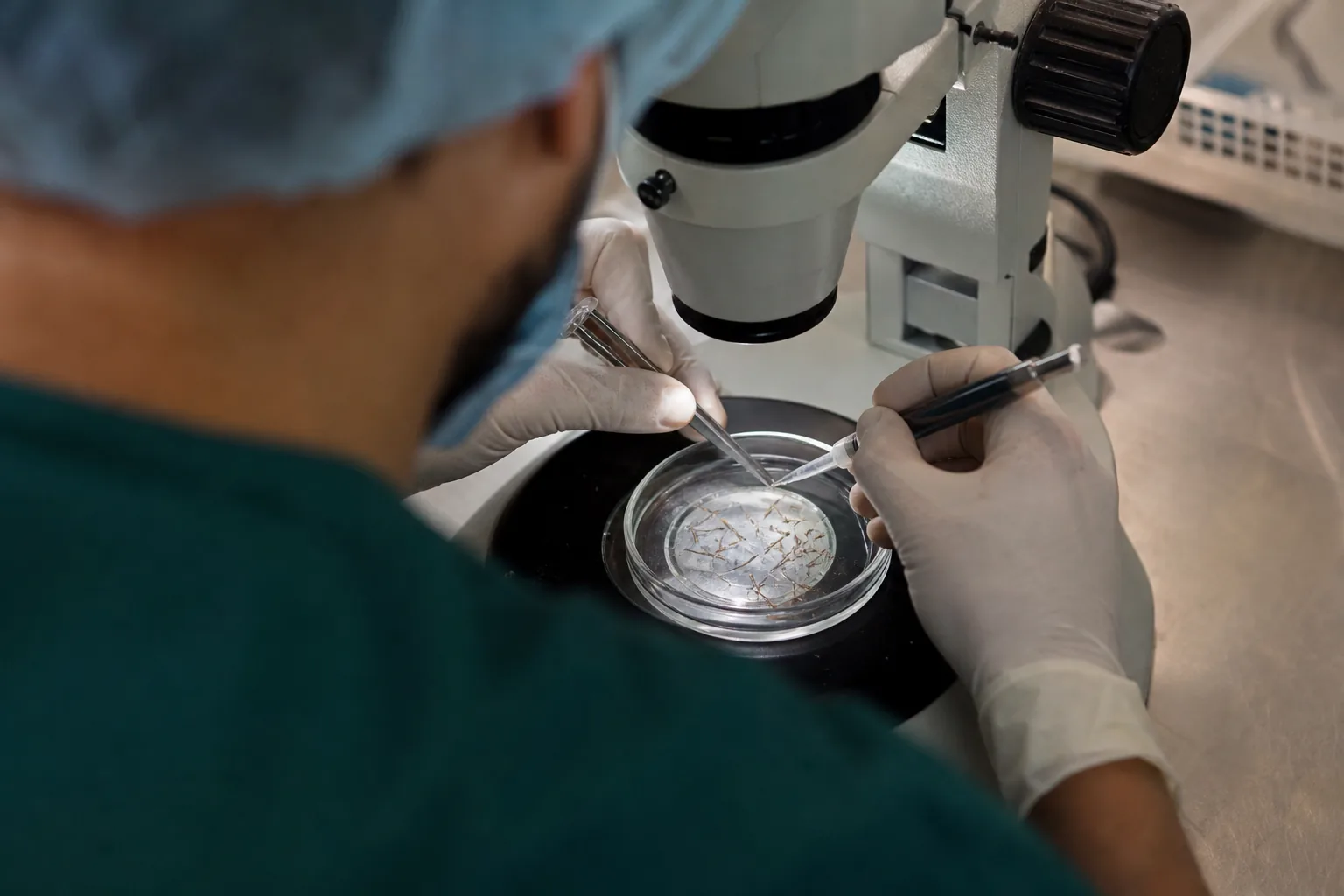
While the surgeon closes the donor wound, a team of technicians takes the strip and dissects it under stereo microscopes into individual follicular units. This is skilled, careful work. Because the units are cut from a strip under magnification rather than extracted blindly through the skin, follicle damage during harvesting is often described as low when the team is experienced. The resulting grafts are then implanted in the same way as FUE grafts, using recipient incisions and forceps.
FUE vs FUT side by side
The table below summarises the practical differences most patients care about. Treat it as a general guide, not a promise. Individual results depend heavily on the surgeon, the team and your own scalp.
| Factor | FUE | FUT (strip) |
|---|---|---|
| Scar type | Many small dot scars spread across the donor area | One fine linear scar across the back of the head |
| Shaving | Donor area usually shaved short, unshaven options exist with lower graft numbers | Only the strip is trimmed, rest of the hair stays long |
| Donor recovery | Small wounds scab and heal within days, mild tightness or redness for a short time | Stitched wound, more tightness and tenderness, stitches out around 10 to 14 days |
| Return to normal activity | Many people return to desk work within about a week | Similar for desk work, but strenuous exercise and stretching of the neck are restricted for longer |
| Max grafts per session | Commonly quoted around 2 000 to 4 000, depending on donor density and the team | Commonly quoted in a similar or higher range, depending mainly on scalp laxity |
| Donor management | Harvests from a wider zone, risk of overharvesting if spacing is poor | Uses the densest central zone, leaves the surrounding area untouched for future FUE |
| Cost tendencies | Widely available, priced per graft or per package, ranges vary hugely by country | Offered by fewer clinics, often priced similarly or slightly lower per graft where both are offered, ask the clinic |
| Who it often suits | People who wear hair short, want to avoid a linear scar, or need a moderate number of grafts | People who wear hair longer, need a large number of grafts, or want to preserve donor reserves |
A closer look at scarring
Both methods leave scars. This is the single most misunderstood point in the whole debate. FUE is often marketed as scarless, and that is not accurate. It leaves many tiny scars instead of one line. With hair clipped very short, a well executed FUE donor area usually looks normal, while a linear FUT scar may show as a thin pale line. With hair at a medium length, both are usually hidden. If you ever want to shave your head completely, neither method is truly invisible, though FUE dots tend to be less noticeable than a line.
A closer look at graft numbers
FUE graft numbers are limited by how densely the donor area can be harvested without visible thinning, and by how long the team can work at a consistent standard in one day. FUT numbers are limited mainly by scalp laxity and the width of strip that can be closed without tension. For someone with a tight scalp, FUE may actually yield more. For someone with a loose scalp and good density, a strip can deliver a large number of grafts in one sitting. If you are unsure where you stand, our article on how many grafts you need explains how surgeons estimate it based on the Norwood scale and the area being covered.
A closer look at cost
Most of the price difference you see online comes from country and clinic, not from the method. FUE is far more widely offered, so you will see many more FUE prices. As typical ranges for a package of about 2 500 grafts, Turkey commonly sits around 1 800 to 4 500 USD, Poland and Hungary around 3 500 to 8 000 USD, the UK around 7 000 to 15 000 USD and the USA around 10 000 to 25 000 USD. Per graft, that translates roughly to 0.70 to 1.80 USD in Turkey, 3.00 to 6.50 USD in the UK and 4.00 to 10.00 USD in the USA.
Here is a simple example. A Norwood 3 patient needing about 2 000 grafts at a UK clinic charging 4.00 USD per graft would be looking at roughly 8 000 USD. The same graft count at 1.20 USD per graft in Turkey comes to about 2 400 USD. Whether that clinic uses FUE or FUT barely moves the number compared with the choice of country. Our hair transplant cost guide breaks this down by country and package type.
Where DHI and Sapphire FUE fit in
Many patients compare FUE, FUT, DHI and Sapphire as if they were four separate methods. They are not. DHI and Sapphire FUE are both variations of FUE. In each case, the grafts are still extracted one by one with a punch. What changes is how the recipient area is prepared or how grafts are placed.
DHI, implanting with pens
DHI (direct hair implantation) uses implanter pens, often called Choi style implanters, to place each graft. The pen creates the site and inserts the graft in one step, so there is no separate stage of opening incisions. Supporters point to precise control over angle and depth and the option to implant between existing hairs without shaving the recipient area. On the other hand, it is typically slower, can need a larger team and often costs more per graft. Our DHI hair transplant page explains when it tends to be recommended.
Sapphire FUE, a different blade
Sapphire FUE refers to the use of sapphire tipped blades to create the recipient incisions instead of steel blades. Clinics that use them describe smoother, finer incisions and potentially quicker healing of the recipient area. The extraction side is standard FUE. It is a refinement of one step rather than a separate procedure, and the skill of the surgeon designing and angling the incisions still matters more than the blade material. See our Sapphire FUE guide for a closer look.
So where does that leave the comparison
The real fork in the road is how grafts are harvested, as a strip (FUT) or as individual units (FUE). Once you have decided that, the choice between classic FUE, DHI and Sapphire FUE is about implantation style, price and the clinic's experience with each. FUT recipient areas can be prepared with steel or sapphire blades too, so the labels are not as separate as some marketing suggests.
Short hair vs long hair wearers
Your everyday hairstyle is probably the most practical way to start narrowing your options.
If you keep your hair short
If you like a short back and sides, a fade, or regularly clip to a low guard, FUE is usually the more comfortable choice. A linear FUT scar can show at very short lengths, and you would be committing to keeping the back of your hair long enough to cover it. FUE dots typically disappear at short lengths once healed, as long as the donor area was not overharvested. Ask to see healed donor photos at the length you normally wear.
If you keep your hair longer
If your hair at the back is usually a few centimetres long or more, a well healed FUT scar is usually hidden. In that case FUT has some practical advantages. You do not need to shave the whole donor area, which matters to people who cannot take time off or do not want anyone to notice a procedure. FUT can also preserve the outer donor zone for future FUE sessions.
If you are not sure yet
Many younger patients do not yet know how they will want to wear their hair in 10 or 20 years. Hair loss also tends to progress, which may mean a future procedure. In that situation, many surgeons recommend thinking about the long term plan first. Which method keeps your options open and protects your donor area best given how much loss you may still face? That is a better question than which method sounds more modern.
Combining FUE and FUT for very large cases
For advanced hair loss, roughly Norwood 5 to 7, the total number of grafts needed over a lifetime can be large and the donor area is a finite resource. Some surgeons combine both methods to get the most out of it.
A common approach is to harvest a strip first, which takes grafts from the densest central part of the donor area, then use FUE in a later session to harvest from the zones above and below the scar. FUE can also be used to place grafts directly into a FUT scar to soften its appearance. Some clinics perform both in the same session, often described as combined or hybrid procedures, though this typically means a long day and a larger team.
The advantage is that the two methods draw from slightly different parts of the donor area, so the combined total over time can be higher than either method alone. The trade off is two types of scarring and more planning. This is a decision for an experienced surgeon who has examined your scalp, not something to choose from a package menu. If you are in this category, a solid estimate of your total graft needs is the first step, which you can get from the estimator on our HairFUE homepage before speaking to clinics.
Recovery and results with each method
The recipient area heals in much the same way with both methods, because the grafts are implanted the same way. Small scabs form around each graft and usually fall away within the first week or two. Transplanted hair often sheds in weeks 2 to 6, which is normal and expected. New growth commonly becomes visible around months 3 to 4, and the final result is typically judged at around 12 to 18 months.
The difference is in the donor area. FUE donor wounds are small and tend to heal quickly, and many people describe little more than tightness and redness for a few days. FUT donor wounds are a stitched incision, so tenderness, tightness and some numbness are more common at first. Patients are usually told to avoid heavy lifting and activities that strain the back of the neck for a few weeks. Rare complications such as infection, poor healing or a stretched scar can happen with either method, and an experienced team lowers the risk.
Final density and naturalness come down far more to the surgeon's planning and the team's skill than to the harvesting method. A well done FUT and a well done FUE can look identical from the front.
Questions to ask a surgeon before you choose
Whichever method you lean towards, a good consultation should leave you with clear answers. Here are the questions worth asking every clinic you consider.
- Which method do you recommend for me, and why? A good answer refers to your hair loss pattern, donor density, scalp laxity, age and hairstyle, not just what the clinic offers.
- Do you perform both FUE and FUT? A clinic that only offers one method may not give you a neutral comparison. That is not a problem in itself, but it is worth knowing.
- How many grafts do you estimate, and how did you arrive at that number? Ask how the estimate relates to the area being covered and the density they plan to achieve.
- How much of my donor area will this use, and what is left for the future? This is the most important long term question, especially if you are young or your loss is still progressing.
- Who does each part of the procedure? Ask who designs the hairline, who makes the incisions, who extracts and who implants. Our article on doctor or technician roles covers why this matters.
- What punch size or strip width do you use? These details affect scarring and are a good test of how openly the clinic explains its technique.
- Can I see healed donor photos at the hair length I wear? Results photos usually focus on the front. The donor area tells you a lot about the team's care.
- What is included in the price? Ask about the number of grafts, medications, aftercare products, follow up checks and what happens if more grafts are needed on the day.
- What does aftercare and follow up look like? Especially if you are travelling abroad, ask how the clinic checks progress at 3, 6 and 12 months.
Comparing answers from several clinics side by side is the quickest way to spot a vague or sales driven reply. A clinic that pushes one method for everyone, without explaining why it fits you, deserves a second look.
Which one fits you, and what to do next
There is no universally better method. FUE is usually the better fit if you wear your hair short, want to avoid a linear scar and need a moderate number of grafts. FUT can make more sense if you wear your hair longer, have a loose scalp, need a large number of grafts in one session or want to protect your donor area for later. DHI and Sapphire FUE are both FUE options with different implantation styles. Very large cases sometimes use both FUE and FUT over time.
The practical next step is to get a realistic estimate of how many grafts you need, then hear from several qualified clinics about which method they would use for your case and why. On HairFUE you can estimate your graft count for free, then use Get 3 quotes to upload your photos once and receive written offers from 3 to 5 matching clinics. Compare their reasoning, their price per graft and their plan for your donor area, then make the choice that fits the way you want to wear your hair for years to come.
Frequently asked questions
Is FUE better than FUT?
Neither is better for everyone. FUE usually suits people who wear their hair short and want to avoid a linear scar. FUT can suit people with longer hair, a loose scalp or large graft needs, and it can help preserve the donor area for later. The surgeon's skill matters more than the method label, so ask why a clinic recommends one for you.
Does FUE leave scars?
Yes. FUE is sometimes marketed as scarless, but every extraction leaves a tiny round scar. When grafts are spread out carefully, these dots are usually hard to see once the hair grows back, even at a short length. Overharvesting can create visible thinning in the donor area, so ask to see healed donor photos.
Are DHI and Sapphire FUE different from FUE?
They are variations of FUE. Grafts are still extracted one by one with a punch. DHI uses implanter pens to create the site and place each graft in one step, while Sapphire FUE uses sapphire tipped blades to make the recipient incisions. The main decision is still strip harvesting versus individual extraction.
Which method allows more grafts in one session?
It depends on your scalp. FUE is limited by donor density and how long the team can work at a consistent standard, while FUT is limited mainly by scalp laxity. Both are commonly quoted in the range of a few thousand grafts per session. A surgeon confirms the realistic number after examining your donor area.
Is FUT cheaper than FUE?
Where a clinic offers both, FUT is often priced similarly or slightly lower per graft, but country and clinic make a far bigger difference than the method. A package of about 2 500 grafts typically ranges from 1 800 to 4 500 USD in Turkey and 7 000 to 15 000 USD in the UK. Always ask exactly what the price includes.
This guide is general information, not medical advice. A surgeon confirms candidacy, graft numbers and price after examining you.