Doctor or Technician, Who Really Performs Your Hair Transplant
, 14 min read, HairFUE editorial team
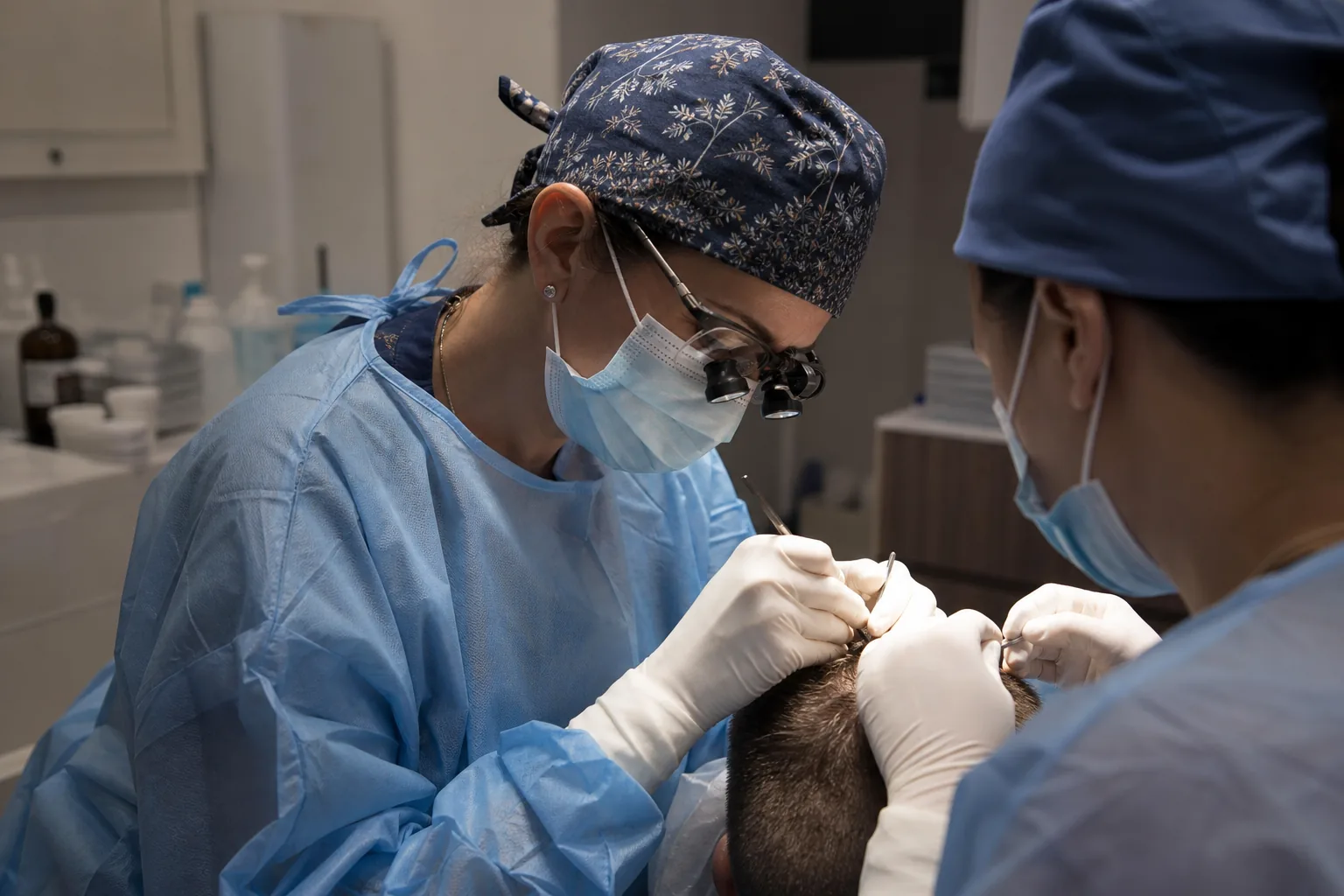
The best hair transplant clinic is one where a named, qualified surgeon personally designs your hairline and makes the recipient incisions, and puts that commitment in writing. Before you compare prices or photos, find out exactly who performs each step of your surgery, because that answer shapes the result more than anything else.
That sounds obvious, yet it is the question many patients never ask. Clinic websites show the lead surgeon on the homepage, the consultation is often handled by a coordinator, and on the day of surgery the room can be full of people in scrubs whose roles nobody explains. Some of them are doctors. Many are technicians or nurses. Whether that is a problem depends on which tasks they do, how they are supervised and what the law allows where the clinic operates. This guide walks through every stage of an FUE procedure, shows who typically handles it in a doctor-led and a technician-led model, and gives you the written questions that separate the two.
Why the person holding the instruments matters more than the brand
An FUE hair transplant is not one action. It is a chain of five or six distinct tasks spread over a long day, usually six to ten hours for a medium-sized session. Each task needs a different skill. Some are mostly about precision and stamina, such as sorting thousands of grafts under a microscope. Others are medical and artistic decisions that you will live with for the rest of your life, such as where your new hairline sits and at what angle each hair grows.
Clinics organise this chain in very different ways. In one clinic the surgeon is at the chair for most of the day and the team supports them. In another, a single surgeon signs off on several patients in parallel while technician teams do most of the hands-on work. Both clinics may use the same marketing words: "experienced medical team", "doctor supervised", "advanced FUE technique". The brochure rarely tells you which model you are buying.
If you have already looked at our overview of how to choose the best hair transplant clinics, you will notice that the surgeon's personal involvement sits near the top of the checklist. This article explains why, step by step.
The steps of an FUE procedure and who typically does each
Here is the usual sequence of a modern FUE day, with the roles you are likely to see. Clinics vary, so treat this as a map for your questions rather than a fixed rule.
Planning and hairline design
The day starts with a consultation in person, a check of the donor area and the drawing of the hairline with a surgical marker. The planner decides how many grafts go where, how dense the front should be, how the temples are shaped and how much donor reserve to keep for the future. A good plan accounts for your age, your likely future hair loss and your facial proportions.
In a doctor-led clinic, the operating surgeon draws the hairline and agrees it with you before anything else happens. In a technician-led model, the hairline is often drawn by a consultant or senior technician, sometimes from a template, and a doctor may glance at it and approve. The difference shows years later, when a hairline that looked fine at 28 looks too low and too straight at 45.
Local anaesthesia
Injecting local anaesthetic into the donor and recipient areas is a medical act in most countries and is normally done by a doctor or, where local rules allow, a qualified nurse. If anyone else does it, ask why.
Graft extraction
Extraction means removing individual follicular units from the donor zone, usually the back and sides of the head, with a small round punch. The person extracting decides punch size, angle and depth, and how evenly to spread extractions so the donor area does not look thinned or patchy. Poor extraction causes transection (cutting through the hair root), which wastes grafts, and overharvesting, which can leave a see-through donor area for good.
In doctor-led clinics the surgeon commonly performs the extractions or at least makes the punch incisions, with assistants removing the grafts afterwards. In technician-led models, extraction is frequently done entirely by technicians using motorised punches. Some technicians are very skilled at this. The legal status of a non-doctor making skin incisions, though, varies by country, and that is a question to ask directly.
Graft handling and sorting
Once extracted, grafts are kept in a cooled holding solution, counted and sorted under magnification into ones, twos, threes and fours (the number of hairs per unit). Single-hair grafts are reserved for the front line, multi-hair grafts go behind for density. Careful handling keeps grafts moist and avoids crushing them.
In almost every clinic, doctor-led or not, this step is done by trained technicians. That is normal and reasonable. It is skilled, patient work, but it does not involve cutting the patient or making design decisions. What you want to know is how experienced the sorting team is and whether grafts are counted and reported to you at the end of the day.
Recipient site incisions
This is the step that most decides how your result looks. The person making the recipient sites cuts the tiny openings in the thinning or bald area where the grafts will sit. In doing so they set the angle, the direction, the depth and the density of every single hair. Whether the blade is steel or sapphire (see our page on sapphire FUE), the tool matters far less than the hand and eye holding it.
In a doctor-led clinic the surgeon makes the recipient incisions personally. In technician-led models this step is often delegated too, and in some places it is done by people with no medical degree at all. If you only ask one question about who does what, ask this one.
Implantation
Implantation means placing each graft into its prepared site, either with forceps or with an implanter pen. In DHI-style techniques, the opening and the placement happen in one movement with the pen. Implantation is commonly done by technicians or nurses in both models, often two or three working at once to keep the grafts out of the body for as short a time as possible. Where the implanter pen creates the opening itself, implantation and site creation become the same act, so the question of who holds the pen becomes more important.
Final check and aftercare instructions
At the end, someone should check the donor and recipient areas, give you a graft count, explain washing and sleeping instructions and tell you who to contact if something looks wrong. In a doctor-led clinic the surgeon usually does a final review. In a high-volume model this may be a coordinator.
The steps side by side
| Step | Doctor-led model (typical) | Technician-led model (typical) |
|---|---|---|
| Planning and hairline design | Operating surgeon, agreed with you | Consultant or senior technician, doctor approval |
| Local anaesthesia | Doctor or qualified nurse | Doctor, nurse or, in some places, others |
| Graft extraction | Surgeon, often with assistants | Technicians, often fully |
| Graft handling and sorting | Technicians | Technicians |
| Recipient site incisions | Surgeon personally | Often technicians |
| Implantation | Technicians or nurses, surgeon nearby | Technicians |
| Final check | Surgeon | Coordinator or technician |
Plenty of clinics sit somewhere in between. A surgeon may design the hairline and make the front recipient sites while senior technicians handle extraction. That can work well, as long as you know about it in advance and the arrangement is legal where the clinic operates.
Why hairline design and recipient sites matter most
Ask experienced surgeons what separates a natural result from an obvious one and most will point to the same two things: the design and the recipient sites. Grafts that are extracted well but placed at the wrong angle grow out like a doll's hair. A dense hairline in the wrong place cannot simply be removed. Hair transplanted into the scalp is permanent in the sense that it keeps growing, which is wonderful when the design is right and a real problem when it is not.
Three reasons make these two steps special.
- They are irreversible. Extraction mistakes can sometimes be hidden by letting the donor hair grow longer. A badly angled or badly positioned graft stays visible, and correcting it means more surgery, often on a donor area that has less to give.
- They use the limited donor supply. Everyone has a finite number of grafts that can be safely taken from the donor zone over a lifetime. Every graft placed in a poor design is a graft that is not available for a future session.
- They need medical judgement. Designing for a 30-year-old who is still losing hair means predicting where loss will go next. That is a clinical decision, not just a technical one.
This is why patients who compare clinics carefully look past the headline graft count. If you want a sense of how many grafts your pattern might need before you talk to anyone, our graft calculator gives a starting range. The surgeon then confirms the real number after examining you.
Regulation differs from country to country
There is no single global rule on who may perform which part of a hair transplant. Each country, and sometimes each region, sets its own rules on what counts as a medical procedure, who may cut skin, who may inject anaesthetic and what a licensed clinic must have on site. In some countries the rules are strict and actively enforced. In others they exist on paper but are applied loosely, or the rules have changed recently and clinics are still adjusting.
We deliberately keep this general, because laws change and details differ. The practical advice is simple: ask the clinic what the local law says about who may perform extraction, recipient site incisions and anaesthesia, and ask them to confirm in writing that their process complies. A clinic that works within the rules usually answers this calmly and quickly. A clinic that gets vague or changes the subject has told you something useful.
It also helps to check basic facts for yourself: is the facility licensed as a medical clinic or hospital, is the operating doctor registered with the national medical authority, and is there an anaesthetist or emergency plan if something unexpected happens. If you are considering travel, our hair transplant Turkey guide covers how to check a clinic before you book flights, and the Turkey hair transplant overview explains what a typical treatment trip includes.
How many patients a surgeon supervises per day, and why it matters
A careful FUE session for around 2 500 grafts takes most of a working day. If one surgeon is personally designing the hairline, making the recipient incisions and checking extraction quality, they can realistically give that level of attention to one patient a day, sometimes two smaller cases. That is simple arithmetic about hours, not a statistic.
Now picture a clinic where one doctor's name is attached to four, six or more patients in different rooms on the same day. The doctor may be qualified and highly skilled, but they cannot hold the instruments for all of those patients at once. In that setting "supervised by a doctor" usually means the doctor moves between rooms, approves plans and handles complications, while technicians do the hands-on surgery.
Some clinics run this model safely and openly, with strong technician teams and clear protocols. The issue is not that technicians are involved. The issue is whether you are told the truth about it, and whether the price you pay reflects what you actually get. When you request offers, ask directly: "How many patients does the surgeon operate on or supervise on the day of my procedure?" A clear number is a good sign. "As many as needed" or "it depends" is not an answer.
What a reasonable answer sounds like
A doctor-led clinic might say: "Your surgeon takes one patient per day. They design your hairline, make all recipient sites and perform the punch incisions. Two technicians assist with graft removal and implantation." A transparent hybrid clinic might say: "The surgeon designs your hairline and creates the recipient sites in the front third. Senior technicians perform extraction under the surgeon's supervision. The surgeon has two patients on that day." Both are honest. You can decide which one you are comfortable with and what each is worth to you.
Questions to ask in writing before you book
Verbal promises in a sales chat are easy to make and hard to hold anyone to. Put your questions in writing and ask for written answers. You can copy this list directly into an email or a message to the clinic.
- What is the full name of the surgeon who will operate on me, and what is their medical registration?
- Who will design and draw my hairline, and will I agree it with that person before the procedure starts?
- Who will perform the graft extractions (punch incisions), and who will remove the grafts?
- Who will make the recipient site incisions? Will the surgeon make all of them, some of them, or none?
- Who will implant the grafts, and with what method (forceps or implanter pen)?
- Who administers the local anaesthetic?
- How many patients does the surgeon operate on or supervise on the day of my procedure?
- What does local law say about who may perform each of these steps, and does your process follow it?
- How many grafts are planned, and will I receive a final graft count at the end of the day?
- Who do I contact after surgery if I have a problem, and does the surgeon review follow-up photos?
- If the named surgeon is unavailable on my date, what happens: do I get a refund, a new date, or a different doctor?
The last question is easy to overlook. Some patients only find out on the day that "their" surgeon is away and a colleague is operating. A good written offer says what happens in that case.
How to verify what you are told
Answers to your questions are only useful if you can check them. There are a few practical ways to do that without being an expert.
A named surgeon in the written offer
The written quote should name the operating surgeon, not just "our medical team". It should state which steps that surgeon performs personally. If a clinic is happy to promise this in a chat message but refuses to put it in the offer, treat the chat message as marketing. On HairFUE, when you use Get 3 quotes, clinics send you written offers you can compare side by side, and you can ask each one to confirm the surgeon and their role in writing before you decide.
A video consultation with the surgeon
Ask for a short video call with the surgeon who will operate, not only with a coordinator. Ten or fifteen minutes is enough to see whether they have looked at your photos, how they think about your hairline and whether they answer the questions above in their own words. A surgeon who will spend the day on your scalp is usually willing to spend a few minutes on a call. If the clinic says the surgeon never speaks to patients before the day of surgery, that tells you how involved they are likely to be.
Doctor profiles and before and after photos
Look at the doctor's profile, their training and how long they have focused on hair restoration. Look at results attributed to that specific surgeon, not just to the clinic. Our clinic directory lets you browse clinics and their doctors in one place, and you can compare the ones that match your plans. Results photos should show the same lighting and angle before and after, and ideally a result at 12 months or later, because transplanted hair commonly sheds in weeks 2 to 6, new growth tends to appear around months 3 to 4, and the final result usually takes 12 to 18 months.
Consistency between answers
Compare what the coordinator said, what the surgeon said on the call and what the written offer says. If the three stories match, good. If the surgeon is "doing everything" in the chat, "supervising" on the call and missing from the offer, you have your answer.
How price relates to the model
Price differences between clinics are not only about country, rent or marketing. They are also about how much of the surgeon's time you are buying. A surgeon who takes one patient a day and personally performs the critical steps has a hard ceiling on how many procedures they can do in a year. That ceiling shows up in the price. A model where one doctor supervises many patients spreads that doctor's cost across more procedures, which can make each package cheaper.
For orientation, these are typical price ranges from public price lists for a package of about 2 500 grafts. They are editorial ranges, not measurements, and every clinic quotes differently.
| Country | Typical price per graft (USD) | Typical package, about 2 500 grafts (USD) |
|---|---|---|
| Turkey | 0.70 to 1.80 (Istanbul up to 2.00) | 1 800 to 4 500 (Istanbul up to 5 000) |
| Poland | 1.50 to 3.20 | 3 500 to 8 000 |
| Spain | 2.00 to 4.50 | 5 000 to 11 000 |
| Germany | 3.00 to 6.00 | 7 000 to 15 000 |
| UK | 3.00 to 6.50 | 7 000 to 15 000 |
| USA | 4.00 to 10.00 | 10 000 to 25 000 |
Take a Norwood 3 patient who needs about 2 000 grafts. In Turkey, at 0.70 to 1.80 USD per graft, that works out at roughly 1 400 to 3 600 USD before any package extras. In the UK, at 3.00 to 6.50 USD per graft, the same 2 000 grafts come to about 6 000 to 13 000 USD. Inside each country, the lower end of the range often reflects higher-volume models, and the upper end more often reflects a surgeon who spends the whole day with you. That is a tendency, not a rule: there are fairly priced doctor-led clinics and overpriced technician-led ones.
The useful question is not "which clinic is cheapest" but "what am I paying for". Two offers at the same price can be very different products if one names a surgeon who makes your recipient sites and the other does not. When you compare the best hair transplant clinics in Turkey or elsewhere, put the surgeon's role next to the price in your own comparison, so you are comparing like with like.
A brief note on safety: the ranges and examples here are estimates for planning, not medical advice. A qualified surgeon confirms your graft needs, your suitability and the plan after examining you.
Finding a doctor-led clinic on HairFUE
You do not need to send the same long email to twenty clinics. On HairFUE, you can estimate your graft range, browse clinics and doctor profiles, and then use Get 3 quotes: upload your photos once and 3 to 5 matching clinics send you written offers. Ask each of them the questions above, insist that the operating surgeon and their role are named in the offer, and book a short video call with the surgeon before you decide. HairFUE is a free comparison marketplace for patients and does not perform surgery itself, so the choice of clinic stays with you.
The best hair transplant clinic for you is the one that tells you plainly who will hold the pen on your hairline, puts it in writing and charges a price that matches that answer. Start your comparison with free written quotes and keep this checklist next to every offer you receive.
Frequently asked questions
Is it normal for technicians to be involved in a hair transplant?
Yes, most clinics use trained technicians for tasks such as graft sorting and often implantation. That is normal. What matters is which steps they perform, how they are supervised and whether local law allows it. Hairline design and recipient site incisions are the steps most patients want the surgeon to do personally, so ask about those specifically and get the answer in writing.
Which step of FUE has the biggest effect on how natural the result looks?
Hairline design and recipient site creation have the biggest effect. The person making the recipient incisions sets the angle, direction and density of every hair, and those choices are hard to reverse. Good extraction protects the donor area, but a poorly designed or poorly angled hairline stays visible. That is why many patients choose clinics where the surgeon performs these two steps personally.
How can I check that the surgeon will actually operate on me?
Ask for the operating surgeon's full name and medical registration in the written offer, along with the steps they perform personally. Request a short video consultation with that surgeon before booking. Then compare what the coordinator, the surgeon and the written offer each say. If the answers match and are specific, that is a good sign. Vague or shifting answers are a warning.
Why does it matter how many patients a surgeon has per day?
A careful FUE session for around 2 500 grafts takes most of a working day. A surgeon who personally designs the hairline and makes the recipient sites can realistically give that attention to one patient a day, sometimes two small cases. If one doctor is attached to many patients on the same day, technicians are doing most of the hands-on work, which you should know before you pay.
Are doctor-led clinics always more expensive?
Often, but not always. A surgeon who takes one patient a day has a limit on yearly procedures, which tends to push prices up, while high-volume models spread costs over more patients. Within typical ranges, such as 0.70 to 1.80 USD per graft in Turkey or 3.00 to 6.50 USD in the UK, compare what each offer includes, especially the surgeon's role, rather than price alone.
This guide is general information, not medical advice. A surgeon confirms candidacy, graft numbers and price after examining you.