DHI hair transplant
A DHI hair transplant is a form of FUE where grafts are loaded into a pen shaped implanter and placed directly into the scalp, without opening channels first. Extraction is the same as classic FUE. Clinics usually charge a premium over a standard package, which runs at $1,800 to $5,000 in Turkey.
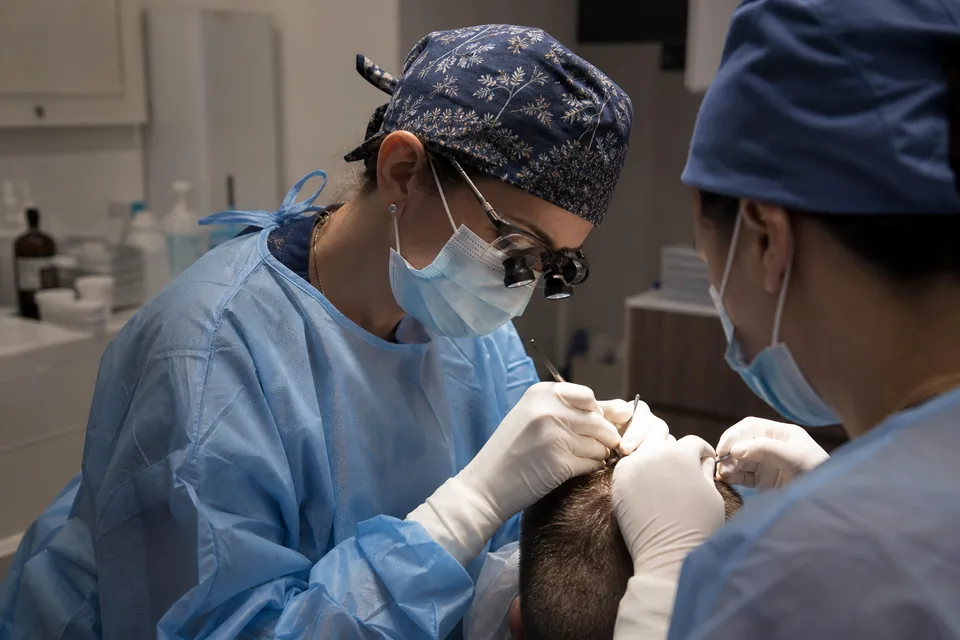
- Typical FUE package in Turkey
- $1,800 to $5,000
- Grafts per session
- Often lower than classic FUE, around 1,500 to 3,000
- Main difference
- Implantation with a pen, no separate channels
How DHI differs from classic FUE
Both methods harvest grafts one by one from the donor area. The difference is in how the grafts go into the thinning zone.
| Step | Classic FUE | DHI |
|---|---|---|
| Extraction | Punch of 0.7 to 1.0 mm | Same punch |
| Recipient sites | Channels opened first with steel or sapphire blades | Created by the implanter needle while placing |
| Placement | Grafts placed with forceps | Grafts loaded into pens and pushed in |
| Shaving | Usually full shave | Recipient area can stay longer in some cases |
| Session size | Large sessions common | Often smaller, because placement is slower |
For the strip method compared with FUE, read FUE vs FUT.
When surgeons suggest DHI
DHI gives the person placing grafts control over angle, direction and depth in one movement. Surgeons often like it for hairlines and for adding density between existing hairs, because there are no pre made channels that could damage native hair nearby.
It is slower and needs more implanter pens and skilled staff, so very large sessions are less common. If you need 4,000 grafts or more, many surgeons prefer classic FUE or a mixed approach.
- Hairline refinement and temple work
- Adding density among existing hair
- Patients who want to keep longer hair in the recipient area
- Smaller to medium sessions
The procedure
A DHI session from start to finish
The day looks a lot like classic FUE. The change comes in the second half.
-
01
Planning
The surgeon checks your donor area and draws the hairline. The graft count is agreed at this point.
-
02
Extraction
Grafts are removed one by one under local anaesthesia and kept chilled in a holding solution.
-
03
Loading the pens
Technicians load each graft into an implanter pen. Several pens are used in rotation to keep grafts out of the body for as short a time as possible.
-
04
Direct implantation
The pen creates the site and places the graft in one push, at the angle the surgeon chooses.
-
05
Aftercare
You get the same washing schedule and recovery timeline as with any FUE session.
Clinics in Turkey to ask about DHI
Profiles of clinics that take patient requests through HairFUE. Ask each one whether the surgeon or a technician uses the implanter pens.
Free for patients
Check whether your graft count suits DHI
Estimate your grafts first. Then ask 3 clinics for written offers and see which technique each surgeon proposes.
Questions
Frequently asked questions
Is DHI better than FUE?
DHI is a type of FUE with a different implantation step. It can help with precise hairlines and dense packing, but results depend far more on the team's skill than on the tool used.
How much does a DHI hair transplant cost?
Clinics usually charge more for DHI than for standard FUE, because it takes longer and uses implanter pens. Standard FUE packages run at $1,800 to $5,000 in Turkey and $6,500 to $18,000 in the UK.
Can I keep my hair long with DHI?
Some clinics offer DHI with the recipient area unshaven. The donor area is usually still trimmed. Ask whether unshaven work limits the number of grafts in one session. Your surgeon will explain the trade off.
Is recovery faster after DHI?
Recovery is similar to FUE. Scabs usually clear within about two weeks, transplanted hairs shed, and new growth starts around month three or four. Most people return to office work within a week, depending on how visible the scabs are.
How many grafts can DHI move in one day?
Many clinics place 1,500 to 3,000 grafts by DHI in a day. Larger sessions are possible with a big team, but ask how long grafts stay outside the body. Shorter times outside the body are better for the grafts.