How Many Grafts Do I Need, Norwood Stages Explained with Graft Ranges
, 13 min read, HairFUE editorial team
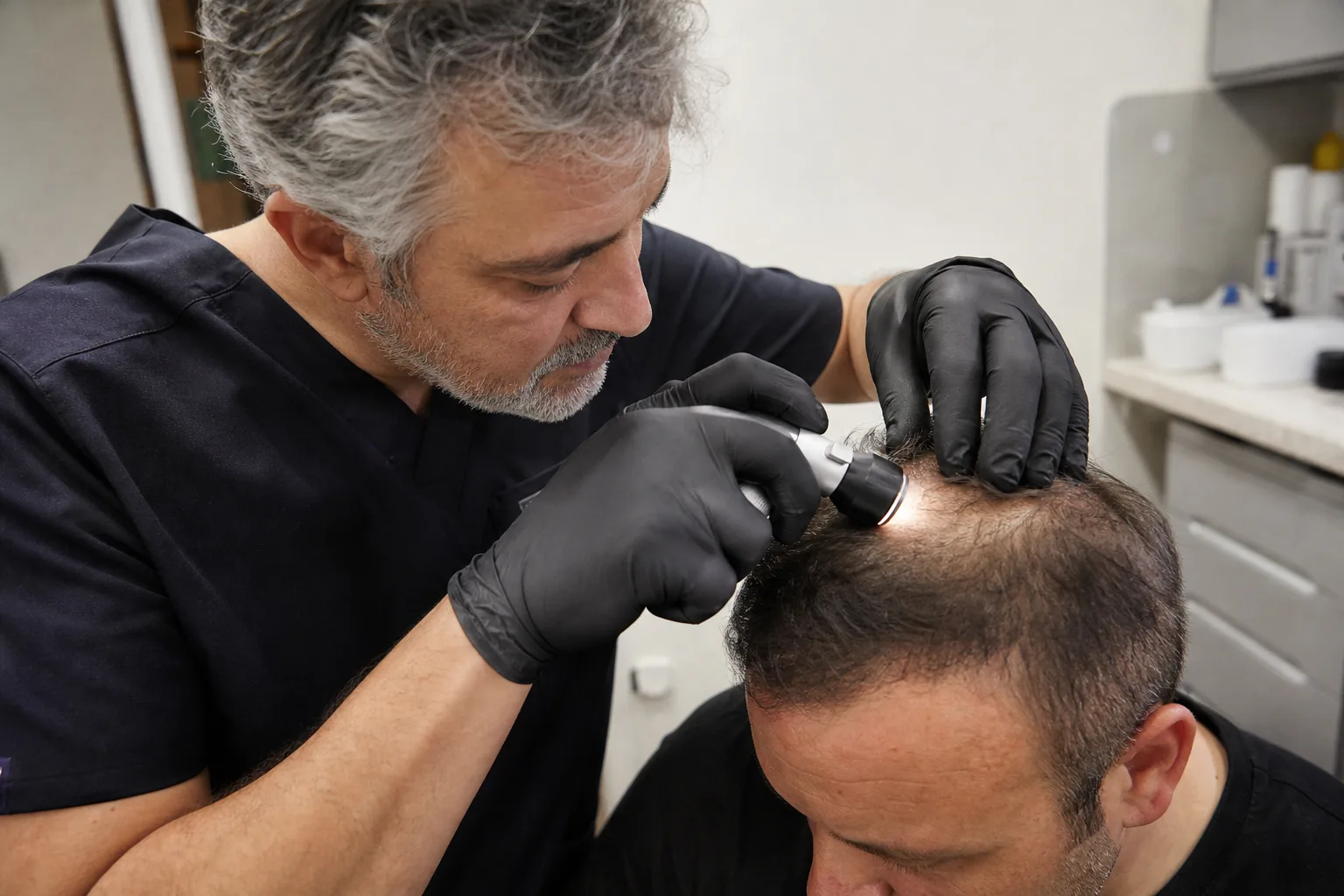
Most men need somewhere between 500 and 6 000 grafts, depending on how far their hair loss has progressed. A Norwood 2 recession commonly takes about 500 to 1 200 grafts, a Norwood 3 about 1 200 to 2 000, and an advanced Norwood 6 or 7 about 3 500 to 6 000, often split across two sessions.
Those numbers are a starting point, not a prescription. The real figure for your head depends on the size of the bald area, how dense you want the result to look, how many hairs grow in each of your follicular units, and, most of all, how much your donor area can safely give. This guide walks through each of those factors so you can read a clinic quote with confidence and spot a plan that looks too ambitious or too thin. If you want a quick number first, the HairFUE graft calculator gives you an estimate in under a minute, and you can come back here to understand what sits behind it.
One note before we start. Every estimate and range in this article is general planning information, not medical advice. A hair transplant surgeon confirms the right graft count only after examining your scalp, your donor density and your hair loss history.
What a graft actually is
A graft is not a single hair. In modern hair restoration, a graft almost always means one follicular unit, the small natural cluster in which hair grows out of the scalp. If you look closely at the back of your head, you will see that hairs rarely emerge one at a time. They come out in tiny groups of one, two, three and occasionally four or five hairs that share the same opening in the skin.
During FUE hair transplant surgery, the surgeon extracts these units one by one from the donor area with a small round punch, then places them into tiny incisions in the thinning zone. Because the unit is moved intact, the transplanted hair grows in the same natural groupings it had before, which is a large part of why a well planned FUE result looks undetectable.
Hairs per graft
Most patients average somewhere around 2 to 2.5 hairs per graft, although this varies from person to person. That average matters more than many people realise. Two patients each receiving 2 000 grafts can end up with noticeably different results:
- A patient averaging 2.0 hairs per graft receives about 4 000 hairs.
- A patient averaging 2.5 hairs per graft receives about 5 000 hairs.
That is a difference of roughly 1 000 hairs from the same graft count. When you compare quotes, it is worth asking each clinic whether its price and estimate refer to grafts or to hairs, because a quote of "4 000 hairs" and a quote of "4 000 grafts" describe very different operations.
Why single hair grafts go to the hairline
Surgeons sort the extracted units by size. One hair grafts are usually reserved for the very front row of the hairline, where a soft, irregular edge looks natural. Two and three hair grafts go behind them to build density, and the largest units are typically placed further back or in the mid scalp. This sorting is one reason graft planning is a design task as much as a counting task.
Norwood stages and typical graft ranges
The Norwood scale (sometimes called the Hamilton Norwood scale) is the standard way to describe male pattern hair loss. It runs from stage 1, with no meaningful recession, to stage 7, where only a horseshoe of hair remains around the sides and back. Clinics use it as shorthand for how large an area needs to be restored.
The table below shows commonly cited graft ranges for each stage. Treat these as approximate planning ranges. They vary from clinic to clinic, and a surgeon may recommend fewer grafts if your donor area is limited or more if you want higher density.
| Norwood stage | What it looks like | Approximate graft range |
|---|---|---|
| Norwood 2 | Slight recession at the temples, hairline moves back a little | about 500 to 1 200 |
| Norwood 3 | Deeper temple recession, a clear M shaped hairline | about 1 200 to 2 000 |
| Norwood 3V (vertex) | Norwood 3 recession plus thinning at the crown | about 1 500 to 2 200 |
| Norwood 4 | Larger frontal loss and a visible bald spot at the crown, still separated by a band of hair | about 2 000 to 2 800 |
| Norwood 5 | Front and crown loss growing closer, the band between them thin | about 2 500 to 3 500 |
| Norwood 6 | Front and crown joined into one large bald area | about 3 500 to 4 500 |
| Norwood 7 | Only a narrow horseshoe of hair at the sides and back | about 4 500 to 6 000, usually across sessions |
Reading the table sensibly
Notice how wide each range is. A Norwood 4 patient might be quoted 2 000 grafts by one clinic and 2 800 by another, and both could be reasonable. The lower number may restore the front and leave the crown for later, while the higher one may try to cover both at moderate density. When quotes differ, the first question is not "who is right" but "which areas is each plan covering, and at what density."
Also notice that the upper stages overlap with what a donor area can provide. That is why Norwood 6 and 7 plans are commonly split into two sessions, often around a year apart, and why surgeons talk about coverage at those stages rather than full density.
The Ludwig scale for women
Female hair loss usually looks different. Instead of a receding hairline, many women see diffuse thinning across the top of the scalp while the frontal hairline stays in place. The Ludwig scale describes this in three broad grades:
- Ludwig 1, mild thinning on the crown and top, often visible as a wider parting.
- Ludwig 2, moderate thinning with clearly reduced volume across the top.
- Ludwig 3, extensive thinning where the scalp is easily visible through the hair on top.
Graft numbers for women are harder to generalise. Diffuse thinning sometimes affects the donor area too, which can make a woman a less suitable candidate for surgery, and treatments that do not involve surgery are often discussed first. Where a transplant is appropriate, it is commonly used to add density along the parting or to lower a high hairline. A careful surgeon will look at donor stability before recommending any number, so women in particular should expect a thorough examination before a graft count is agreed.
Donor capacity, the real limit on your total
The donor area is the band of hair at the back and sides of the head that is generally resistant to pattern hair loss. Because those follicles tend to keep growing after they are moved, the donor area is the raw material for every transplant you will ever have. It is also finite.
Each follicular unit can be extracted only once. Take too many and the back of the head starts to look patchy or see through, which is a problem that is very hard to fix. Good surgeons plan extraction so that the donor area still looks full after the operation, even with short hair.
What decides how many grafts you can give
- Donor density, meaning how many follicular units grow in each square centimetre at the back and sides.
- Size of the safe donor zone, which varies with head size and with how far your own hair loss is expected to progress.
- Hair calibre and colour. Thick hair and a low contrast between hair and skin colour create more visual coverage per graft.
- Hairs per graft. A donor rich in two and three hair units delivers more hair for the same number of extractions.
- Previous surgery. Someone who has already had a transplant has less left to give.
Lifetime donor capacity is commonly discussed in a range of several thousand grafts, and it differs a lot between individuals. This is the main reason a responsible clinic will sometimes recommend fewer grafts than you hoped for. If one clinic promises a very large single session without examining your donor area, treat that as a reason to ask more questions, not as a bonus. Our guide to FUE vs FUT also explains how the choice of extraction method can affect how much donor hair is used.
Density per cm2 and the zones of the scalp
Graft planning becomes clearer once you think in terms of density. A full head of natural hair commonly has somewhere around 70 to 100 follicular units per square centimetre. A transplant does not need to recreate that full density to look good, because the eye perceives fullness well before original density is reached. Surgeons often aim for something closer to half of natural density in key areas, adjusted for hair type and donor supply.
The basic arithmetic works like this. Area in square centimetres multiplied by planned grafts per square centimetre gives the graft count. A frontal area of 50 cm2 planted at 40 grafts per cm2 needs about 2 000 grafts. The same area at 30 grafts per cm2 needs about 1 500. Small changes in planned density move the total a lot.
Hairline
The hairline is the most visible part of any transplant. It is planted with single hair grafts in an irregular, slightly staggered pattern so that it looks soft rather than drawn with a ruler. Density here is usually high, but the area is narrow, so the graft count for the hairline itself is moderate.
Front third
Directly behind the hairline, the front third frames the face and gives most of the visual impression of a full head of hair. Surgeons commonly put the highest density here, using two and three hair grafts. For many Norwood 3 and 4 patients, restoring the hairline and front third gives the biggest improvement per graft.
Mid scalp
The mid scalp sits between the front and the crown. Depending on how you style your hair, it may need only moderate density, especially if the front is strong and you comb hair backward over it.
Crown
The crown, or vertex, sits at the top back of the head where hair grows in a spiral, often called the whorl. It is planned last in many cases and deserves its own section.
Why the crown needs so many grafts
Patients are often surprised that a bald spot at the crown can take as many grafts as the whole front. There are several reasons.
- The spiral growth pattern. Hair at the crown radiates outward in different directions. Grafts must follow that pattern, which spreads them out and means each hair covers less skin than hair lying flat at the front.
- Light and viewing angle. The crown is seen from above under overhead light, which shows the scalp through thin hair more easily.
- The area keeps growing. A crown that is thinning now may expand over the years. Planting it fully at a young age can leave an island of transplanted hair if the surrounding hair is lost later.
- Area. A large vertex can cover more square centimetres than people imagine, and the arithmetic of area times density adds up quickly.
For these reasons, many surgeons recommend prioritising the hairline and front, then treating the crown in a later session once the pattern of loss is clearer and the donor budget is better understood. If a plan spends a large share of your donor supply on the crown first, ask why.
Planning for future hair loss
Pattern hair loss is usually progressive. The hair you have today between the transplanted zone and the donor area may thin over the next ten or twenty years. A good graft plan accounts for that.
Age and stability
Younger patients, especially those in their early twenties, often have not yet shown how far their hair loss will go. Surgeons commonly advise caution in this group: a conservative hairline, a moderate first session, and a clear discussion of medical treatments that may slow further loss. An aggressive low hairline at 23 can look odd at 45 if the rest of the hair recedes behind it.
Keeping grafts in reserve
A sensible plan does not spend the entire donor area in one go. Keeping a reserve means you can return later to add density or treat new thinning. When you compare offers, look for a plan that explains what is used now, what is left, and how the result should hold up if your loss continues. A useful question to ask any clinic is "if my hair loss progresses by one Norwood stage, what would my next step be, and do I have the donor hair for it?"
Multiple sessions
At Norwood 6 and 7, two sessions are common. The first typically restores the hairline and front, the second adds coverage to the mid scalp and crown. Sessions are usually spaced far enough apart for the first result to grow out, since transplanted hair often sheds in weeks 2 to 6, new growth tends to appear around months 3 to 4, and the final result is commonly seen around 12 to 18 months.
Turning your graft count into a cost
Once you have a realistic graft range, you can estimate cost. Clinics price in one of two ways: a price per graft, or a fixed package that covers a set number of grafts (often around 2 500) plus extras such as consultations, medication or accommodation. Our page on hair graft cost explains per graft pricing in detail, and the full hair transplant cost guide covers packages and what they include.
The table below shows typical per graft ranges by country, taken from public price lists. These are editorial ranges for planning, not measured averages, and individual clinics can sit outside them.
| Country | Typical price per graft (USD) | Typical package, about 2 500 grafts (USD) |
|---|---|---|
| Turkey | 0.70 to 1.80 (Istanbul up to 2.00) | 1 800 to 4 500 (Istanbul up to 5 000) |
| India | 0.60 to 1.50 | 1 500 to 3 800 |
| Poland | 1.50 to 3.20 | 3 500 to 8 000 |
| Hungary | 1.50 to 3.20 | 3 500 to 8 000 |
| Czech Republic | 1.80 to 3.50 | 4 000 to 8 500 |
| Mexico | 1.50 to 3.50 | 3 500 to 8 500 |
| Thailand | 1.50 to 3.50 | 3 500 to 8 500 |
| Greece | 2.00 to 4.00 | 4 500 to 10 000 |
| Spain | 2.00 to 4.50 | 5 000 to 11 000 |
| Germany | 3.00 to 6.00 | 7 000 to 15 000 |
| UK | 3.00 to 6.50 (London 3.50 to 7.50) | 7 000 to 15 000 (London 8 000 to 18 000) |
| USA | 4.00 to 10.00 | 10 000 to 25 000 |
Worked examples
Here is how the arithmetic looks for a few common situations, using the ranges above.
- A Norwood 3 patient needing about 2 000 grafts. At 0.70 to 1.80 USD per graft in Turkey, that works out at about 1 400 to 3 600 USD. At 3.00 to 6.50 USD per graft in the UK, it comes to about 6 000 to 13 000 USD.
- A Norwood 4 patient needing about 2 500 grafts. At 1.50 to 3.20 USD per graft in Poland, that is about 3 750 to 8 000 USD. At 4.00 to 10.00 USD per graft in the USA, it is about 10 000 to 25 000 USD.
- A Norwood 6 patient needing about 4 000 grafts over two sessions. At 2.00 to 4.50 USD per graft in Spain, the total is about 8 000 to 18 000 USD. At 0.70 to 1.80 USD per graft in Turkey, about 2 800 to 7 200 USD, although many Turkish clinics sell packages that cap the graft count, so check what a second session would cost.
Watch the package limits
Packages can be good value, but read the small print. Some packages promise "unlimited" or "maximum" grafts, which in practice means whatever the surgeon decides on the day. Others set a fixed number and charge extra above it. Always ask who performs the extraction and implantation, how the final graft count is confirmed, and whether you receive a written count after surgery. If you are leaning toward travelling abroad, our Turkey hair transplant page explains how package pricing usually works there.
How to get a reliable graft estimate
Online ranges help you prepare, but your own number should come from a surgeon who has seen your scalp. You can get much closer to that number before you travel or book by following a few steps.
- Start with an estimate. Use the graft calculator or the estimator on the HairFUE homepage to see a range for your Norwood stage and the areas you want to restore.
- Take clear photos. Front, top, crown, both sides and the donor area at the back, in good light, with dry hair. Photos of the donor area are just as important as photos of the bald area.
- Ask for written offers. Compare graft counts, the zones each plan covers, the planned density, the price and who performs each stage of surgery.
- Compare plans, not just prices. A cheap quote for 4 000 grafts that ignores your donor limits is worse value than a careful quote for 2 500 grafts that leaves you a reserve.
Your next step on HairFUE
The question "how many grafts do I need" has a range for an answer until a surgeon looks at your scalp. Your Norwood stage gives the starting point, your donor area sets the ceiling, and the density you want in each zone decides where in the range you land.
HairFUE makes the next part simple. Run your numbers in the graft calculator, then use Get 3 quotes to upload your photos once and receive written offers from 3 to 5 matching clinics. You can compare their graft counts, plans and prices side by side, and ask each one the questions from this guide before you decide. HairFUE is a comparison service, not a clinic, so the final graft count is always confirmed by the surgeon who examines you.
Frequently asked questions
How many grafts do I need for a Norwood 3?
A Norwood 3 is commonly quoted at about 1 200 to 2 000 grafts, enough to rebuild the temples and the front hairline at good density. If you also have thinning at the crown (Norwood 3V), the range moves to about 1 500 to 2 200. Treat these as approximate planning ranges; a surgeon confirms the right number after examining your scalp and donor area.
How many hairs are in one graft?
A graft is one follicular unit, a natural cluster of one to four or occasionally five hairs. Most patients average roughly 2 to 2.5 hairs per graft. That means 2 000 grafts can deliver around 4 000 to 5 000 hairs, so always check whether a clinic quotes in grafts or in hairs before comparing offers.
Is there a maximum number of grafts I can have?
Yes. Your donor area at the back and sides of the head is finite, and each follicular unit can be extracted only once. Total capacity depends on donor density, head size, hair calibre and previous surgery, and it differs a lot between people. Responsible surgeons plan extraction so the donor area still looks full and keep a reserve for the future.
Why does the crown need so many grafts?
Hair at the crown grows in a spiral, so grafts are spread in several directions and cover less skin each. The crown is also viewed from above under overhead light, which reveals thinning easily, and the bald area may keep expanding. Many surgeons therefore restore the hairline and front first and treat the crown in a later session.
How do I turn a graft count into a price?
Multiply your graft estimate by the per graft price in the country you are considering. For example, 2 000 grafts at a typical 0.70 to 1.80 USD per graft in Turkey comes to about 1 400 to 3 600 USD, while the same count at 3.00 to 6.50 USD in the UK is about 6 000 to 13 000 USD. Packages may cap the graft number, so read what is included.
Can I trust an online graft calculator?
An online calculator is a good planning tool that gives a realistic range for your hair loss stage and the areas you want restored. It cannot measure your donor density or hair calibre, so it is not medical advice. Use the estimate to compare clinic offers, then let a surgeon confirm the final number after an examination.
This guide is general information, not medical advice. A surgeon confirms candidacy, graft numbers and price after examining you.