Hair Transplant Recovery Timeline, Day by Day and Month by Month
, 14 min read, HairFUE editorial team
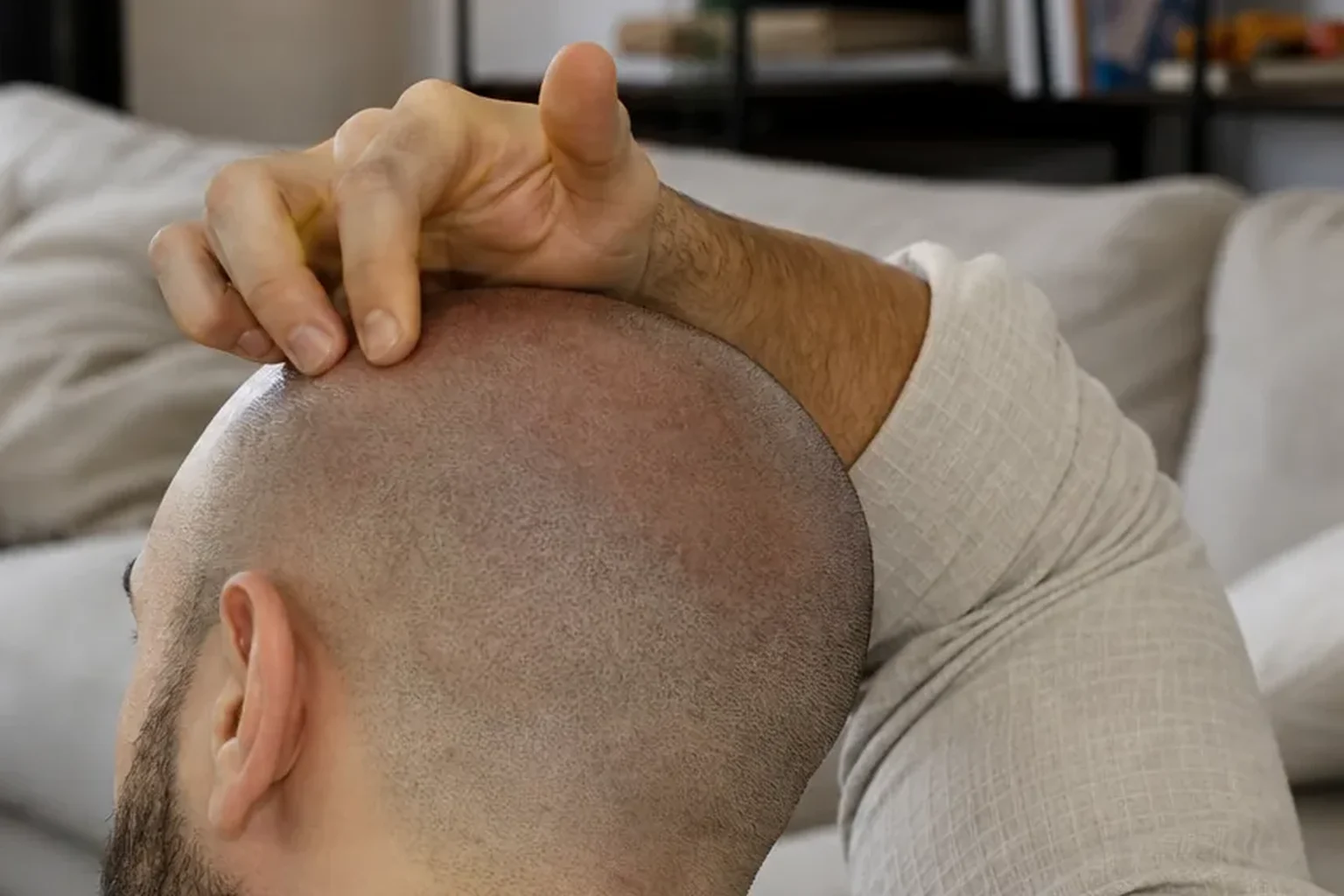
A typical hair transplant recovery timeline looks like this: swelling and tenderness in the first three days, scabs that clear by about day 10, shedding of transplanted hairs between weeks 2 and 8, new growth from months 3 to 4, and a final result at 12 to 18 months.
That is the short version. The longer version matters, because the recovery is where most of the worry happens. People are rarely nervous about the surgery day itself once it is booked. They get nervous on day 5 when the scabs itch, in week 4 when the new hairs fall out, and in month 3 when the mirror looks worse than it did before the operation. Knowing what is normal at each stage makes those moments much easier to sit through.
This guide walks through the recovery day by day for the first two weeks, then month by month until the final result. It covers sleeping position, the first wash, flying home after surgery abroad, going back to work, exercise, sun, alcohol, hats and swimming. One rule runs through all of it: your surgeon's written aftercare instructions come first. The windows below are typical ranges that many clinics quote, not a plan for your scalp. Estimates and ranges on this page are not medical advice, and a surgeon confirms what applies to you after examination.
The full recovery timeline at a glance
The table below summarises what most patients can expect after an FUE hair transplant. FUT recovery follows a similar pattern for the grafts, with the extra factor of a linear donor wound that needs stitch care, which we cover in our comparison of FUE vs FUT.
| Stage | What usually happens | What you typically do |
|---|---|---|
| Surgery day | Local anaesthetic, extraction and implantation over several hours, bandage on the donor area | Go home or to the hotel, rest, take prescribed medication only |
| Days 1 to 3 | Tenderness, mild bleeding spots, swelling of forehead and sometimes around the eyes | Sleep with the head raised, avoid touching grafts, follow spray or saline routine |
| First wash, often day 1 to 3 | Gentle wash, usually at the clinic or by their method | Copy the clinic technique exactly, no rubbing, no strong water jet |
| Days 4 to 10 | Crusts and scabs form, itching starts, swelling fades | Keep washing gently, let scabs soften and come away on their own |
| Days 10 to 14 | Scalp mostly clean, redness fading, short stubble visible | Many people return to most normal routines with surgeon approval |
| Weeks 2 to 8 | Shock loss, transplanted hairs shed | Do nothing special, this is expected |
| Months 2 to 3 | The ugly duckling phase, thin and patchy look | Patience, a hat or short cut if it bothers you |
| Months 3 to 4 | New fine hairs start to appear | Normal care, watch for occasional ingrown hairs |
| Month 6 | Noticeable density at the front, hairs still thin | Take progress photos in the same light |
| Month 12 | Most of the result visible, texture improving | Review with the clinic |
| Months 12 to 18 | Final result, crown often last to mature | Final review, discuss long-term plan with a doctor |
Every scalp heals at its own pace. Smokers, people with tight scalps, large sessions and crown work often run a little slower. If your timeline drifts by a few weeks in either direction, that is usually no cause for concern. If something looks wrong rather than slow, the warning signs section further down tells you when to call a doctor.
Surgery day and the first three days
Surgery day
An FUE session normally takes most of a day. The surgeon or team marks the hairline, numbs the donor and recipient areas with local anaesthetic, extracts individual follicular units from the back and sides of the head, opens small channels in the thinning area and places the grafts. For a patient needing around 2 500 grafts, many clinics plan one long day with breaks for food.
When you leave, the donor area is often bandaged and the recipient area is left open or lightly covered. You will usually receive written aftercare instructions, a saline or similar spray, sometimes a special shampoo, and any medication the doctor prescribes. Read the instructions that evening while the details are fresh, and keep them somewhere you can find them at 3 a.m. when a question pops into your head.
Plan for a quiet evening. You have been sitting or lying still for hours, the anaesthetic is wearing off, and the scalp will feel tight. Someone to accompany you back to the hotel or home is a good idea, and many clinics abroad include transfers for exactly this reason.
Days 1 to 3, swelling and sleeping position
The first three days are about protecting the grafts. In this early window they sit in their channels but are not yet firmly anchored, so knocks, scratching and friction are the main risks.
Swelling is common. Fluid from the anaesthetic and the procedure tends to move downward with gravity, so the forehead may puff up around day 2 or 3, and some people get swelling around the eyes. It usually settles within a few days. Clinics often recommend sleeping with the head raised at roughly a 45 degree angle, using two or three pillows or a travel neck pillow so you do not roll onto the grafts. Some clinics also recommend cold packs on the forehead, never directly on the grafts. Follow whatever your clinic suggests.
Small spots of blood and a little oozing from the donor area are normal early on. Mild tenderness is normal too. Strong pain that keeps getting worse is not, and belongs in a call to the clinic.
Practical points for these days:
- Do not touch, scratch or press the recipient area.
- Avoid bending forward for long periods, as it tends to increase swelling.
- Wear button-up shirts so nothing has to be pulled over the head.
- Take only the medication your doctor prescribed or approved.
- Keep the spray routine if your clinic gave you one.
The first wash
The first wash is a moment many patients dread, and there is no single correct method. Some clinics do it themselves on day 1 or day 2, which is common in clinics that treat international patients. Others teach you to do it at home on day 2 or 3. The usual pattern is a gentle lather of shampoo or foam applied with light patting, left for a short time, then rinsed with a cup or a very gentle shower stream, with no rubbing and no towel scrubbing. Pat dry or let it air dry.
The key is to copy the clinic instructions exactly, including how many times a day and for how many days. If you are told to apply a lotion to soften the crusts first, do it. If anything is unclear, ask the clinic before you start rather than improvising.
Days 4 to 10, scabs and itching
By day 4 most of the swelling has usually eased and the scalp starts to look like a healing wound rather than a fresh one. Each graft site forms a tiny crust. Together they can look like a fine layer of brown or red flakes across the recipient area.
The crusts usually loosen and fall away with the daily washes between days 7 and 10, sometimes a little later on large sessions. Many clinics allow slightly firmer, but still gentle, fingertip pressure once the grafts are more secure, often around day 7 to 10. Picking at scabs is the classic mistake. A scab pulled off early can take a graft with it, which is the one thing you cannot undo.
Itching tends to arrive in this window as the skin heals. It can be annoying rather than painful. The usual approach is to keep up the washes and spray, avoid scratching completely, and ask the clinic if the itch becomes intense, because they may suggest something to calm it.
The donor area also heals during these days. With FUE it shows as many tiny dots that are hidden as the surrounding hair grows. Short-haired donor areas often look close to normal within a couple of weeks. Numbness or tingling in either area is common and usually fades over weeks to a few months.
Flying home, work, exercise and daily life
This is the section with the most questions, especially from people travelling for surgery. Remember that the windows here are typical ranges quoted by many clinics. Your surgeon may set different ones based on your session, technique and health.
Flying home after surgery abroad
Many patients who choose a hair transplant in Turkey or another country stay two or three nights after surgery. That usually covers the procedure, a check the next day and the first wash at the clinic. Short-haul and long-haul flights are commonly allowed after that, but a few practical habits help:
- Ask the clinic for a loose, soft hat or hood suitable for the flight, so the overhead locker and headrest do not touch the grafts.
- Use a travel neck pillow to keep your head upright if you sleep.
- Pack the spray, shampoo and written instructions in your hand luggage, keeping within liquid limits.
- Be careful lifting bags into overhead lockers, as straining and bending can increase swelling.
- Drink water and move your legs on longer flights.
Before booking, ask the clinic how many nights they want you to stay, whether the first wash is done on site, and how they handle follow-up questions once you are home. Clear aftercare for remote patients is a good sign. Our guide to hair transplant costs in Turkey also explains what packages typically include, such as hotel nights and transfers.
Returning to work
For desk and remote work, many people return within 3 to 7 days. The main question is not physical ability but how comfortable you are with visible scabs and redness. If you want nobody to notice, 10 to 14 days off is more realistic, especially with a shaved head. Physical or dusty jobs, roles that need a helmet or hard hat, and heavy lifting often need more time, commonly around two weeks or what the surgeon advises.
Exercise
Exercise raises blood pressure and sweating, both of which you want to avoid while grafts settle. A common pattern clinics give is gentle walking from the first days, light exercise after about 1 to 2 weeks, and gym work, running and heavy weights after about 3 to 4 weeks. Contact sports, or anything where your head can be hit, often wait longer. Ask your surgeon for their specific dates.
Sun exposure
New grafts and healing skin are sensitive to sunburn. Many clinics recommend avoiding direct sun on the scalp for the first few weeks and covering up in strong sun for several months. Sunscreen on the treated area is usually only allowed after the skin has healed, so check with the clinic before applying anything.
Alcohol and smoking
Alcohol can thin the blood and add to swelling. Many clinics ask patients to avoid it for several days before and after surgery, often around a week after. Smoking reduces blood flow to the skin, and most clinics advise stopping before surgery and staying off cigarettes for as long as possible afterwards, at least through the early healing weeks. Again, follow your own clinic's guidance.
Hats
Hats are one of the most common questions. Most clinics say a loose, clean hat or soft hood is fine fairly early, sometimes from the first days, as long as it does not press on or rub the grafts and is put on and taken off carefully. Tight caps, beanies and helmets usually wait longer, often around 10 to 14 days or more. Ask before you wear anything that sits firmly on the recipient area.
Swimming
Pools, the sea, saunas and steam rooms are usually off the list for a few weeks because of chlorine, salt, heat and the risk of infection. A common window is about 2 to 4 weeks for swimming and a bit longer for saunas, depending on the clinic. Holiday plans are worth discussing before you book the surgery date.
Shock loss and the ugly duckling phase
Weeks 2 to 8, shock loss
Somewhere between week 2 and week 8, most patients notice the transplanted hairs falling out. For many people this happens around weeks 2 to 6. It can feel alarming after paying for surgery, but it is a normal and expected part of the process. The hair shaft sheds while the follicle beneath the skin stays in place and goes into a resting phase before it grows again.
Some people also notice shedding of existing native hair near the recipient area. This is also often called shock loss. In many cases those hairs grow back over the following months, although hair that was already miniaturising and close to falling out may not. Your surgeon can explain how much of this to expect given your pattern of loss.
Months 2 to 3, the ugly duckling phase
After the shedding comes a period that patients often call the ugly duckling phase. The scabs are long gone, the transplanted hair has fallen out, the new growth has not arrived yet, and the area can look thin, patchy or even a little worse than before surgery. Redness may still be visible in fair skin.
This is the hardest stage psychologically, and it is completely normal. Nothing you see in the mirror at this point tells you how the result will turn out. A short haircut that blends the area, a hat, or simply not checking the mirror every hour all help. Taking photos once a month in the same light and at the same angle gives you a far more reliable record than daily checks.
Months 3 to 18, new growth to final result
Months 3 to 4, new growth begins
New growth is commonly visible from around month 3 to 4. The first hairs are often fine, thin and sometimes wavy or a little lighter in colour. They thicken over the following months. Some people notice small spots that look like pimples as new hairs push through the skin. These are usually harmless and settle on their own, but spots that are painful, spreading or full of pus are worth showing to the clinic.
Month 6
By month 6, many patients see clear progress, particularly in the hairline and the front. The hairs are longer and starting to give coverage, though density and texture are not final. This is a good moment for a check-in with the clinic, either in person or by sending photos.
Month 12
At around 12 months, most of the result is usually visible. Hairs have gained thickness and the styling options start to match what was planned. Many clinics call this the main review point. If you want to see how results tend to look at this stage, our before and after gallery shows photo sets at different points in recovery.
Months 12 to 18, the final result
The final result is generally judged between 12 and 18 months. The crown is often slower than the front, partly because of how hair grows there and partly because crown work tends to be spread over a larger area. It is common for the hairline to look finished at 12 months while the crown keeps improving for several months more. Judging the crown too early is a frequent source of unnecessary disappointment.
Warning signs that need a doctor
Most recovery problems are minor, but some signs need medical attention rather than waiting. Contact your clinic, and a local doctor if you are home from abroad, if you notice any of the following:
- Signs of infection. Increasing redness, warmth, swelling that gets worse after the first few days instead of better, yellow or green discharge, or a bad smell from the donor or recipient area.
- Fever or chills. A raised temperature after surgery is not part of normal healing.
- Persistent or worsening pain. Tenderness should ease day by day. Pain that grows stronger, or that does not respond to the medication you were given, needs checking.
- Bleeding that does not stop with gentle pressure as instructed by the clinic.
- Swelling around the eyes that affects vision, or any sudden, severe swelling.
- Numbness or pain that spreads or persists well beyond the usual months.
- Painful cysts or lumps that keep returning in the recipient or donor area.
If you had surgery abroad, ask the clinic before you leave how to reach them, who answers, and what happens if you need to be seen locally. A clinic that gives a clear answer is easier to work with if anything goes wrong.
Long-term maintenance and protecting the result
Transplanted follicles are usually taken from the donor area because those hairs tend to be resistant to the pattern of loss that affects the top of the head. That is why transplanted hair is generally long lasting. The native hair around it, however, can continue to thin over the years. Someone who has a hairline restored at 30 may see the area behind it thin further by 40 if the underlying hair loss continues.
For this reason, many surgeons talk about long-term maintenance at the consultation. This can include medical treatments, regular reviews and, for some people, the possibility of a second session later. Which approach, if any, suits you is a question for a doctor who knows your history and can explain the benefits and risks. We do not recommend any specific medication here, and you should never start or stop a treatment without medical advice.
Planning ahead also affects the first surgery. A surgeon who expects further loss may design a more conservative hairline and keep donor reserves for the future. When you compare offers, ask how the clinic plans for the next 10 to 20 years, not just for the next 12 months. The question of who actually performs each step matters too, which is why it is worth reading about whether a doctor or technician does the key parts of the procedure.
Planning your own recovery with HairFUE
Recovery is easier when the plan is clear before you travel or book time off. Start by estimating the size of your procedure with the graft estimator on the HairFUE homepage, because a session of 1 500 grafts and one of 3 500 grafts can mean different time off, different nights abroad and a different budget. As a simple example, a patient needing about 2 500 grafts in Turkey at typical ranges of 0.70 to 1.80 USD per graft would be looking at roughly 1 750 to 4 500 USD, in line with typical package ranges of 1 800 to 4 500 USD. The same session in the UK at 3.00 to 6.50 USD per graft would be roughly 7 500 to 16 250 USD before packages. These are typical ranges, not quotes.
Then compare how clinics handle aftercare. Ask each one how many nights they want you to stay, when the first wash happens, what follow-up they offer at 6 and 12 months, and how quickly they answer questions once you are home. With Get 3 quotes, you upload your photos once and 3 to 5 matching clinics send written offers, so you can compare aftercare plans side by side along with price and technique. HairFUE is free for patients and is not a clinic. Your chosen surgeon confirms the graft count, the plan and the recovery instructions after examining you.
Frequently asked questions
How long does it take to recover from a hair transplant?
Most people feel physically recovered within 7 to 14 days, once swelling has gone and the scabs have cleared. The hair itself follows a longer timeline. Transplanted hairs typically shed in weeks 2 to 8, new growth starts around months 3 to 4, and the final result is usually judged at 12 to 18 months, with the crown often slowest.
When can I go back to work after a hair transplant?
Many people with desk or remote jobs return within 3 to 7 days. If you prefer that nobody notices the scabs and redness, 10 to 14 days off is more realistic. Physical jobs, dusty environments and roles that need a helmet often need around two weeks or longer. Your surgeon sets the final date based on your session.
Is it normal for transplanted hair to fall out?
Yes. Shedding of the transplanted hairs, often called shock loss, is expected and commonly happens between weeks 2 and 8. The hair shaft falls out while the follicle stays under the skin and rests before growing again. Some nearby native hair may shed as well. New growth usually becomes visible from around month 3 to 4.
When can I fly home after a hair transplant abroad?
Many clinics ask international patients to stay two or three nights, covering the surgery, a next day check and often the first wash. Flying is commonly allowed after that. Wear a loose soft hat, use a neck pillow, keep your aftercare products in hand luggage and avoid straining when lifting bags. Always confirm the date with your clinic.
When can I exercise, swim or wear a hat after surgery?
Typical windows quoted by clinics are light exercise after 1 to 2 weeks, gym work and running after about 3 to 4 weeks, and swimming after 2 to 4 weeks, with saunas later. Loose clean hats are often allowed early if they do not touch the grafts, while tight caps and helmets wait longer. Your surgeon's instructions come first.
What signs after a hair transplant need a doctor?
Contact your clinic or a local doctor if you notice increasing redness, warmth or swelling after the first few days, pus or a bad smell, fever or chills, pain that keeps getting worse, bleeding that does not stop with gentle pressure, or swelling that affects your vision. These are not part of normal healing and should be checked promptly.
This guide is general information, not medical advice. A surgeon confirms candidacy, graft numbers and price after examining you.